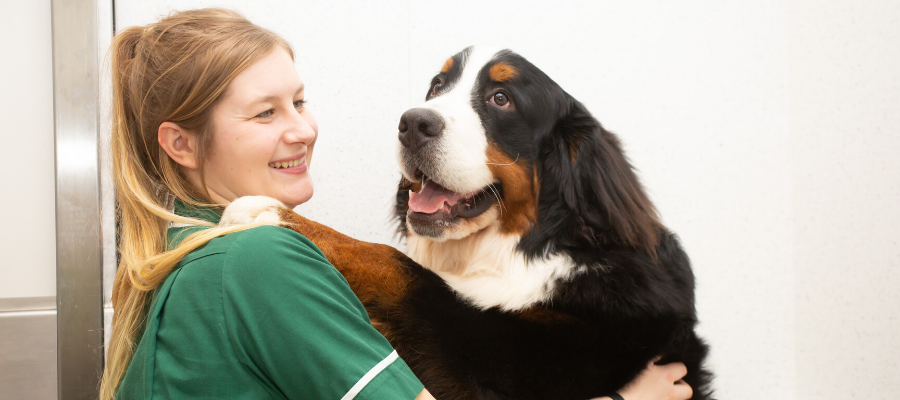
If your dog is young, fit and healthy and you have decided not to breed from them in the future, we fully recommend neutering, which has a number of advantages.
What are the benefits of neutering my female dog?
- Preventing unplanned, unwanted and costly offspring and complications associated with pregnancy.
- Preventing pyometra (infection of the uterus, which can be fatal).
- Eliminating the risk of ovarian cancer.
- Reducing the risk of mammary tumours (if performed before one year of age).
- Reducing the risk of diabetes mellitus.
What are the benefits of neutering my male dog?
- Eliminating the risk of testicular cancer.
- Reducing the risk of some benign prostate diseases.
- Can reduce hormonal-based behaviours such as roaming and humping.
What is involved in the procedure?
In female dogs we offer two methods of spaying- the conventional spay, which removes the ovaries and uterus, or the laparoscopic (keyhole) spay, where only the ovaries are removed. It has been shown that removal of the uterus is unnecessary when ovaries are removed and does not result in a pyometra (infection of the womb) where no hormones are present. After a conventional spay, your dog will need to be kept quiet and calm, with restricted exercise for 10 days. A keyhole spay is less invasive and the recovery time is quicker, with dogs returning to normal exercise around 5-7 days later.
In male dogs we remove the testicles surgically; this is a simpler procedure than spaying a bitch. Your dog will need to return for a check up and suture removal 10-14 days after their operation. Your dog will need to be kept quiet and a calm the day after procedure, with exercise restricted for 5 days post-operatively.
Procedures are performed under general anaesthetic and patients are monitored carefully by vets and nurses throughout the procedure and recovery.
How long does it take?
Surgery is performed in the morning and most patients recover so quickly that they only stay with us for a few hours and are ready to go home after a light lunch.
When can I have my dog neutered?
We usually recommend spaying bitches 3 months after their first season, however, we will spay from 6 months old (before their first season), after a check over with the vet. If you decide to wait until your bitch is older, we still recommend spaying 3 months after the end of their season.
Male dogs can be castrated from 6 months of age but, especially with large/giant breeds, we recommend waiting until they are fully grown to ensure their growth plates have closed. This can prevent mobility and joint issues when they get older.
What are the risks to neutering?
Male dogs
If a male dog is neutered before puberty, they are at risk of delayed growth plate closure, which increases the risk of joint problems as they mature. This is particularly evident in large/giant breeds. Also, while castration reduces the risk of many prostatic diseases, there is a small increased risk of prostatic neoplasia in castrated males.
Nervous dogs can become more nervous following castration, as the testosterone, produced in the testicles, has been removed, removing the confidence they do have. In this scenario, it is worth discussing with a vet whether castration is the best option for your dog.
There is the option to use a chemical castration implant, which gives the exact same benefits of castration, but wears off after 6-12 months, depending on the size of implant you choose. This can be a good place to start if you are unsure how castration will affect your dog’s personality.
Female dogs
In female dogs, weight gain is a common side effect of neutering (spaying). However, this can be managed at home with a change in diet and nutrition.
Urinary incontinence affects approximately 3% of all female dogs (regardless of neutering status) and studies show that some female dogs are at increased risk of urinary incontinence after neutering. This is more likely in large breed dogs, or if neutering is performed before six months of age/before the first season. However, it has now been suggested that this only occurs when there was already an underlying bladder condition, which the loss of hormones exacerbates.
Laparoscopic Spay
What is laparoscopy?
Laparascopy or ‘keyhole surgery’ has become much more popular within veterinary medicine in recent years purely because of the advantages to the patient. Instead of performing surgery in the conventional way through an 8-12cm incision, the procedure is performed through two very small incisions, 1cm in diameter.
What are the advantages of a laparoscopic spay?
The procedure is less painful than traditional surgery. Dogs will recover more quickly and return to exercise faster. Wound management is a lot easier; the two very small incisions heal up a lot faster. This is particularly advantageous in young, bouncy patients.
Is my dog suitable for a laparoscopic spay?
Bitches must be at least 6 months of age and over 5 kilograms.
Is there limited availability and how far in advance do I need to book?
Our vets Philip Snyman and Ian Killian perform the laparoscopic surgeries and they operate on specific days of the week. Is it best to call 1-2 weeks in advance to book your pet in.
Are there any greater risks with a laparoscopic spay compared to a conventional spay?
The risks are no different between a conventional spay and a laparoscopic spay. In very rare cases the laparoscopic spay might need to be converted to a conventional spay, for example if there is a large amount of bleeding which cannot be stopped.
Call us on 01435 864422 to book an appointment today.